
The sales director is presenting a loss analysis to his leadership team. Three enterprise deals, same pattern: all three evaluators had spent meaningful time using the competitor’s product before the first call - not in a free trial, not in a live demo. They’d found an interactive demo on the competitor’s homepage and just played with it. “By the time they talked to that sales team,” he says, “they’d already decided.” The room is quiet. Someone asks what was on their own homepage. He doesn’t answer. Everyone already knows: three screenshots and a “Book a Demo” button.
An interactive product demo is a clickable, guided version of a software product that lets prospects explore core workflows without a login, setup, or sales call. Unlike a screenshot or recorded video, it responds to user input — buttons work, data filters, workflows progress — giving buyers a genuine product experience rather than a description of one.
If you’re not sure what separates an interactive demo from everything else in your marketing stack, you’re almost certainly losing deals to companies that have already made this distinction. This is the complete guide — what it is, how it differs from free trials, videos, and live demos, and why it has become the most leveraged asset in modern B2B sales.
01 - The Definition
Prospects who experience your product interactively before talking to a rep convert at 2.4× the rate of standard marketing-qualified leads (G2 / Forrester). That stat raises an obvious question: what are they experiencing? The answer is an interactive product demo - a clickable, guided simulation of your software that runs entirely in a browser, with no installation, no account creation, and no salesperson required.
It responds to user input: buttons do things, data filters and sorts, workflows progress from step to step. The prospect isn’t watching a recording of someone using your product. They’re using it - or something that faithfully recreates the experience of using it.
Three properties define it and separate it from everything else in your marketing stack.
It’s clickable. The prospect takes action; the demo responds. This isn’t semantic - it’s the entire point. The transition from passive observation to active participation changes the cognitive experience completely. Watching someone drive a car tells you almost nothing about what it feels like to drive it.
It’s self-contained. No friction at the front door. The prospect doesn’t need credentials, a sandbox environment, or a fifteen-minute onboarding sequence. They arrive, they click, they learn. The absence of setup friction is the reason interactive demos reach audiences that free trials never do - people who are curious but not yet committed.
It’s instrumented. Every click, every path taken, every drop-off point generates data. This behavioral intelligence - what features hold attention, where people get confused, which workflows trigger genuine interest - is as valuable as the demo itself. A demo that isn’t tracked is a missed opportunity to understand your own market.
An interactive demo is not a better screenshot. It’s a different category of asset: one that creates experience rather than describing it.
02 - Not All Demos Are Equal
The word “demo” is doing too much work in most sales conversations. It’s used interchangeably for things that are fundamentally different experiences. Here’s what actually separates the formats - and why the distinction matters more than most sales teams realize.
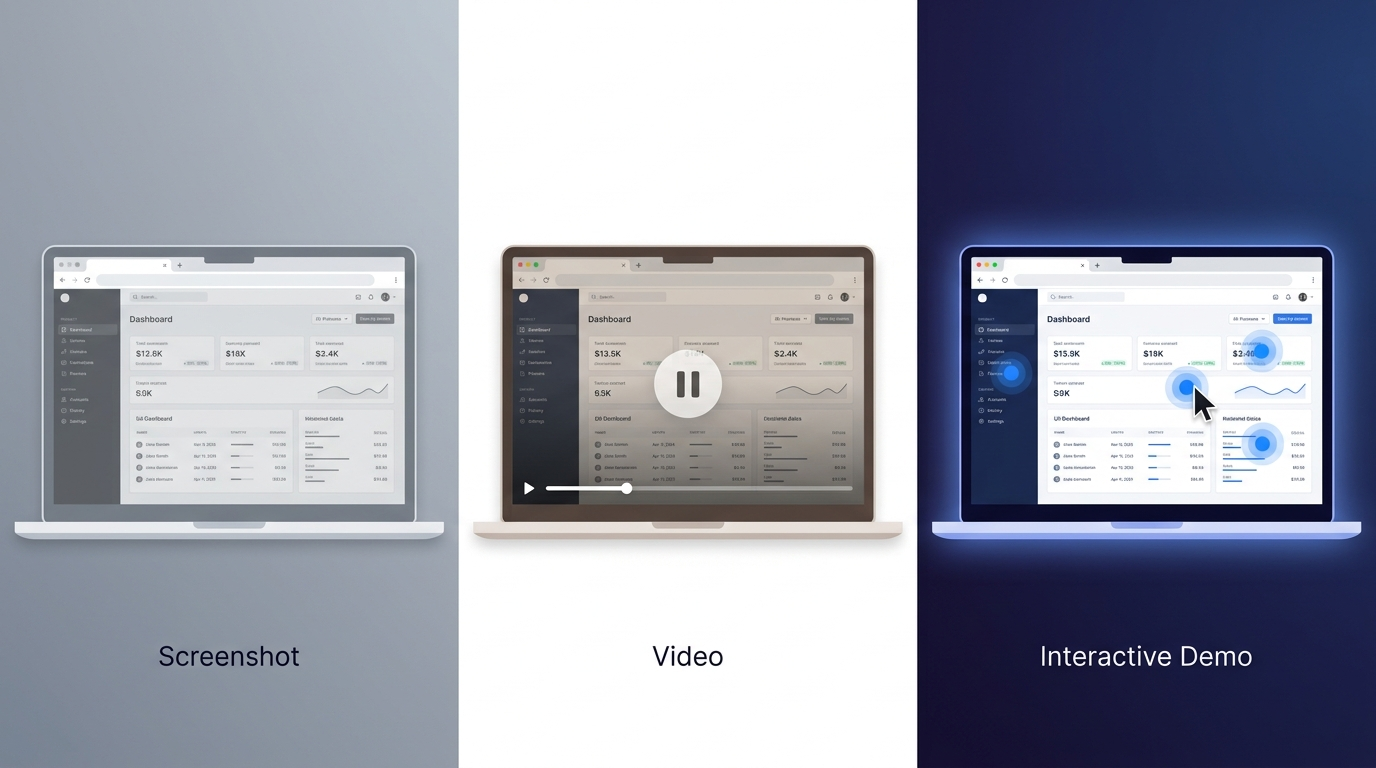
Screenshots are static images of your product. They require the prospect to mentally reconstruct the experience from a freeze-frame: to imagine what clicking a button would do, to guess what that chart means in context of real data, to project the full product from a single moment. That’s guesswork, not evaluation. And when buyers are guessing, they default to doubt. As we argued in our earlier piece on why static screenshots are killing your sales, the cognitive load screenshots impose actively works against conversion.
Video walkthroughs are a meaningful improvement - they add motion, context, and narrative. But they’re still passive. The prospect watches; they don’t do. There’s no sense of agency, no ability to follow a different path, no response to specific curiosity. Video also can’t answer the unasked questions: “What happens if I filter by this?” “Can I do X from here?” Interactive demos can. Videos can’t.
Live sales demos are human-dependent and time-gated. They require scheduling, an available rep, and a prospect willing to commit thirty to sixty minutes before they’ve decided they’re actually interested. They’re a powerful closing tool. They’re a terrible first exposure.
Interactive product demos sit in a category of their own: always available, always consistent, self-directed, and data-generating. They work for the prospect researching at midnight, for the CFO who wants to form an independent view before the vendor call, for the internal champion building a business case who needs something to share. No other format does all of that.
| Format | Buyer can click? | No login required? | Works async / 24–7? | Tracks behavior? | Best for |
|---|---|---|---|---|---|
| Static screenshot | No | Yes | Yes | No | Docs, release notes |
| Video walkthrough | No | Yes | Yes | Partially | Awareness ads, social |
| Free trial | Yes | No — account required | Yes | Yes | Bottom-funnel, committed buyers |
| Live sales demo | Yes | No — scheduled call | No | Partially | Late-stage enterprise deals |
| Interactive product demo | Yes | Yes | Yes | Yes | Top/mid-funnel, self-serve qualification |
03 - Why Does It Actually Convert Better?
Demo-qualified leads convert at 2.4× the rate of standard MQLs (G2 / Forrester). Companies running self-serve interactive demos report sales cycles 40% shorter on average (OpenView PLG Index). These aren’t marginal gains - they’re structural differences in pipeline quality. Why?
The psychology is well-documented. Behavioral economists have identified the endowment effect: people assign more value to things they feel they possess or have interacted with than to identical things they’ve only observed. The moment a prospect starts clicking through your product - filtering data, completing a workflow, seeing a result they caused - they begin building a form of psychological ownership. The product starts to feel like theirs.
There’s a related phenomenon called the IKEA effect, documented by Norton, Mochon, and Ariely (2012): people overvalue things they’ve had a hand in creating or assembling. A prospect who spends eight minutes actively navigating your demo has invested effort. That effort becomes attachment. Attachment becomes preference. Preference becomes a deal.
Interactive content also holds attention in ways static content can’t. Research from the Content Marketing Institute shows dwell times 3 to 5 times higher for interactive experiences versus passive content. In an environment where the average B2B landing page holds a visitor for 54 seconds before a bounce (Nielsen Norman Group), the difference between passive and interactive isn’t incremental - it’s the entire game.
There’s also a selection effect worth naming. The prospects who complete an interactive demo are self-selected for genuine interest. They didn’t engage because a rep followed up twelve times - they showed up on their own, chose to stay, and formed a view independently. That’s a categorically different kind of lead than anything inbound forms or cold outreach produce, and the conversion data reflects it. Navattic’s 2025 State of the Interactive Product Demo report - drawn from 28,000 demos - found that deals involving two to three demo touches achieve a 72% win rate, and companies using interactive demos report 20–30% increases in overall win rates (Navattic, 2025).
04 - Where Does an Interactive Demo Fit in Your Sales Process?
67% of B2B buyers now prefer a rep-free buying experience - up from 61% just nine months earlier (Gartner, March 2026, n=646). That’s not a niche preference - it’s the majority. The question for sales teams isn’t whether to offer a self-serve path, but where in the buying journey to put it. For a complete breakdown of why gated demos are losing deals to companies that offer this experience upfront, see Why Gated Sales Demos Lose Deals. The short answer: everywhere you currently have a static asset. But the highest-leverage placements depend on where your prospect is.
Top of funnel - homepage and product pages. This is the highest-leverage placement for most companies. Your homepage is where peak buying intent meets your highest traffic. A prospect who arrives with a specific question and finds an interactive demo gets an answer immediately, without booking a call. The demo does the work your “Book a Demo” button used to defer to a sales rep.
Mid-funnel - outbound sequences and leave-behinds. After a cold outreach, a link to an interactive demo changes the ask entirely. Instead of “can I have thirty minutes of your time to show you something?” it becomes “here’s something to explore at your convenience.” By the time a prospect responds, they’ve already seen the product. Your rep’s time goes entirely to qualification and relationship, not introduction.
Bottom of funnel - personalized demos per account. Enterprise teams increasingly build one personalized interactive demo per target account - swapping in the company logo, replacing generic data with industry-relevant benchmarks, tailoring the guided tooltips to known pain points. Sent as a leave-behind after discovery, a personalized demo keeps the product present during the evaluation period between meetings. It also gives the internal champion something concrete to share with stakeholders who weren’t on the call.
None of these use cases replace great salespeople. They make great salespeople more efficient by handling the work that doesn’t require a human - so the humans can focus entirely on the work that does. The teams getting the best results from interactive demos treat them as a force multiplier, not a substitute.
Interactive demos don’t remove salespeople from the process. They remove the part of the process that was never a good use of a salesperson’s time.
05 - What Does a Great Interactive Demo Actually Contain?
Not all interactive demos convert equally. The format is a vehicle; what you put in it determines whether it works. Here’s what the demos that actually move deals have in common - and what most teams get wrong.
It starts at the aha moment - not the login screen
Most demos begin where a user session begins: authentication, onboarding, the empty dashboard. This is exactly wrong. Start where the value becomes undeniable. Skip the setup. Skip the navigation. Drop the prospect directly into the moment where the product does the thing that makes it worth buying.
It uses realistic data that looks like the prospect’s world
A demo populated with “Vantage Inc” and placeholder metrics communicates nothing. Realistic data - industry-appropriate numbers, recognizable workflow patterns, the kind of records an actual user would encounter - makes the experience feel true. The prospect’s brain stops translating and starts evaluating.
It guides without lecturing
Guided hotspots and brief tooltips point the prospect toward the next important action without interrupting the sense of self-direction. The best interactive demos feel like exploration, not a tour. The prospect should feel like they discovered something - not like they were shown something.
It ends with a clear next step
A demo without a call to action is a conversation that ends mid-sentence. At the conclusion of the experience - immediately after the highest-value moment - there should be a single, friction-free next step: start a trial, book a call, or share this with a colleague. The prospect is at peak interest right now. Don’t let the moment pass.
It tracks everything from day one
Which step do people drop off at? Which feature gets the most dwell time? How many reach the CTA? This data is a continuous signal about what your market actually cares about - more honest and more current than any focus group. A demo without behavioral analytics is an asset that can’t improve.
05.5 - Interactive Product Demo Examples
The format is versatile — the same underlying asset is deployed differently depending on where the buyer is in their journey. Here are the three highest-impact placements:
Homepage demo
Embedded directly on the homepage or a “Take a Tour” CTA. Ungated, 3–5 steps, focused on the single highest-value workflow. Its job: answer “is this for me?” before the buyer has to ask. This is the highest-leverage placement — peak buying intent meets peak traffic.
SDR follow-up demo
Sent as a tracked link in an outbound sequence or post-discovery-call email. Longer than the homepage demo (8–12 steps), often role-specific — “the RevOps view” or “the sales leader’s view.” Instead of asking for 30 minutes to show the product, the SDR sends the product. By the time the prospect replies, they’ve already formed a view.
Champion share link
A customized demo built after a discovery call — the prospect’s company name in the data, their industry’s terminology in the tooltips, a narrative that matches their stated buying criteria. Shared with the CFO, the CTO, and the end-users who weren’t on the call. The internal champion stops re-explaining from memory and shares a consistent product story instead.
06 - How Do You Get One Without an Engineering Team?
The most common reason sales and marketing teams don’t have an interactive demo is the mistaken belief that building one requires engineers. It doesn’t - at least not anymore. The tooling landscape has split into three paths, each with real trade-offs.
No-code capture platforms let you record your product through a browser extension and publish a click-through version with annotations. They’re fast to produce (often same-day) and require no technical knowledge. The trade-off is fidelity: first-generation capture platforms overlay interactive elements on screenshots, so the experience can feel slightly synthetic and doesn’t always reflect the latest product state.
Custom engineering builds give you complete control and maximum fidelity - your demo literally runs on the same HTML as your product. The trade-off is cost and time. A fully custom interactive demo built by engineers is a significant investment, takes weeks, and requires ongoing maintenance as the product changes. Most early-stage companies can’t justify it.
Purpose-built platforms like SwiftDemos sit between those two options. A Chrome extension captures your live product and produces a fully editable HTML demo - real markup, not screenshots - that embeds directly on your site with built-in analytics and custom branding. No engineering team required. With plans from $39/month, billed annually ($468/year), or $50/month billed monthly, you can build reusable sales assets with a monthly or annual subscription.
The right choice depends on your team’s technical capacity, how frequently your product changes, and how closely the demo needs to mirror actual product behavior. What isn’t a valid choice: doing nothing and keeping the screenshots. Once you’ve chosen a platform, our step-by-step guide on how to create a product demo that converts covers the exact structure and checklist to build one that sells without a presenter.
Coda - The Shift Is Already Happening
The companies adding interactive demos to their sales motion aren’t doing it because it’s trending. They’re doing it because the economics are unambiguous. A demo-qualified lead converts at 2.4× the rate of a standard MQL. Sales cycles compress by 40%. Time on page triples. The ROI isn’t subtle.
What’s worth sitting with: interactive demos are still a competitive differentiator right now. Navattic tracked a 56% year-over-year increase in interactive demos built in 2024 versus 2023 - adoption is accelerating, but the majority of B2B companies still don’t have one (Navattic, 2025). Most of your competitors haven’t made the switch. The window where this move earns outsized returns won’t stay open indefinitely.
Your best sales rep can’t be on call at midnight for every curious prospect. Your interactive demo can.
FAQ - Common Questions
What is an interactive product demo?
An interactive product demo is a clickable, guided simulation of your software that runs in a browser - no installation, no login, and no salesperson required. Unlike a screenshot or recorded video, it responds to user input: buttons work, data filters, and workflows progress. Prospects experience the product directly rather than having it described to them.
What’s the difference between an interactive demo and a free trial?
A free trial is your real product - with all the setup friction, empty data, and onboarding overhead that comes with it. An interactive demo is a curated experience built around your highest-value workflows, designed to communicate value in minutes rather than days. Most teams use interactive demos to qualify interest before offering a trial.
How long should an interactive product demo be?
Short enough to reach the aha moment without detours - typically 5 to 10 steps for a top-of-funnel demo, up to 15–20 for a detailed mid-funnel version. The right length is whatever it takes to communicate your core value proposition without asking for more attention than the prospect is willing to give at that stage.
Can interactive demos replace live sales demos?
Not entirely - and that’s not the right goal. Interactive demos replace the first contact that used to require a 45-minute intro call. They handle early-stage education and self-qualification at scale. Live demos remain valuable for late-stage deals, complex enterprise evaluations, and moments where a human relationship actually moves the needle.
Where should I put my interactive demo?
Your homepage is the highest-leverage placement - where peak buying intent meets highest traffic. Beyond that: product or features pages, outbound email sequences as a leave-behind, sales decks as an embedded link, and post-discovery-call follow-ups. The more places a prospect can encounter your product before talking to a rep, the better.
Statistics cited reflect industry research from G2, Forrester, OpenView Partners, and Content Marketing Institute. Individual results vary by product category, target market, and demo quality.
Build interactive demos that close deals.
No engineering team required. Go from Chrome capture to a shareable, trackable demo in minutes.
Start Free Trial