
The product manager pulls up the activation report on a Tuesday morning. Signup numbers are fine. But the seven-day activation rate — the percentage of new users who complete a core workflow within a week — is sitting at 23%. She knows what that means: the other 77% are staring at an empty dashboard, deciding whether to stay or leave before the product has shown them anything worth staying for. In the same meeting, the sales lead shares his own numbers. Demo request conversion: 8%. Of everyone who hits the “Book a Demo” button, only eight out of a hundred end up talking to a rep. The rest leave before the call ever happens. Both problems have the same root cause — and they don’t have the same solution.
SaaS conversion is broken in two different places, and most teams try to fix both with the same tool. They build a product tour and call it done, or they add an interactive demo and assume that covers onboarding. It doesn’t. Product tours and interactive demos solve different problems at different stages of the buyer journey — and confusing the two is one of the most consistent conversion mistakes in B2B SaaS.
So what actually works better? The answer depends entirely on what you mean by “converts” — and who you’re trying to convert to what. This is the full breakdown.
01 - Quick Answer
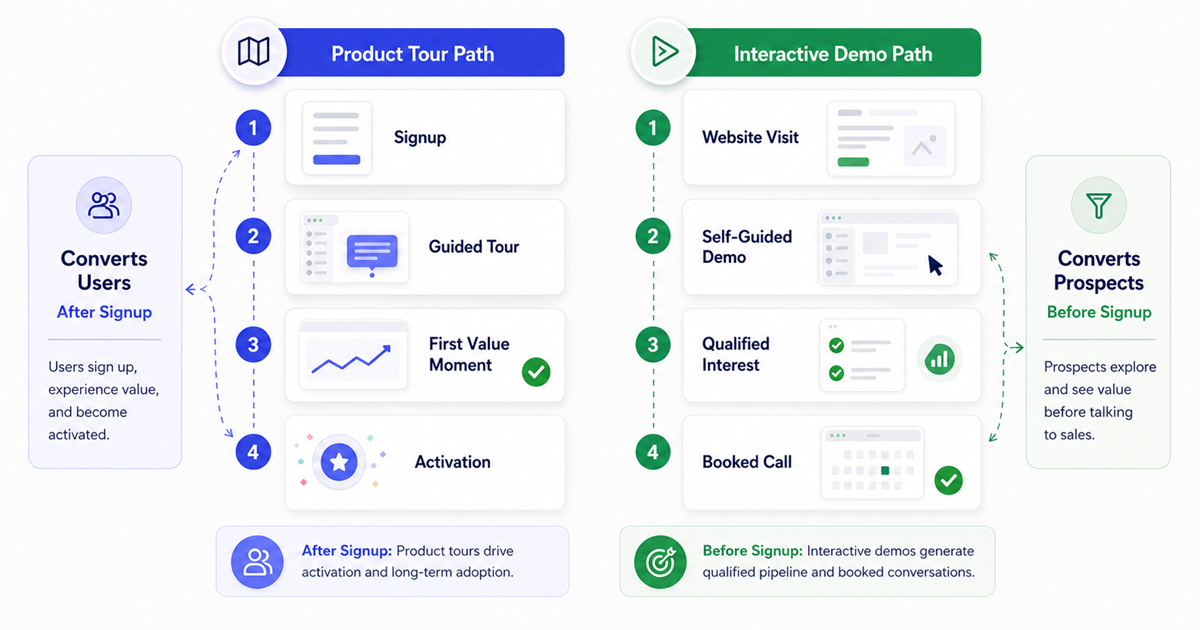
If you need a decision right now: product tours convert faster for activation; interactive demos convert better for sales evaluation. The fastest-growing SaaS companies use both — in sequence. A self-guided interactive demo gets a prospect from “curious” to “qualified” before they ever talk to a rep. A product tour gets a new user from “signed up” to “activated” before they ever consider churning. Neither replaces the other. They operate at different moments in the funnel, for different audiences, with different definitions of “convert.”
If you only have resources for one right now: build the interactive demo first. It expands the top of your funnel, compresses the first evaluation step, and creates a behavioral signal that a standard form fill can’t capture: the prospect has already clicked through the product and shown what they care about. The product tour becomes critical at scale, when activation rates start mattering more than acquisition rates.
02 - What Is an Interactive Product Tour?
An interactive product tour is a guided, step-by-step walkthrough of your product’s core features — optimized to get a user from signup to their first moment of genuine value as fast as possible. It’s almost always delivered inside your live product (or a close simulation of it), and the defining characteristic is structure: the path is fixed, the sequence is intentional, and the user is directed rather than left to explore.
Think of a product tour as a choreographed first experience. It might use tooltip overlays, progress indicators, and spotlights to draw attention to specific UI elements in a deliberate order. The user can’t easily deviate — that’s the point. The tour removes the blank-page problem of landing in an empty dashboard and not knowing where to start.
Key characteristics:
- Guided — a fixed sequence of steps, not open exploration
- In-product or simulated — runs inside the real product or a faithful recreation of it
- Short — typically 5 to 10 steps, targeting the aha moment as directly as possible
- Onboarding-focused — designed for new users post-signup, not pre-sale prospects
A product tour is a guided hand through the front door. It gets someone from signup to value — fast. It’s not designed to close a deal.
03 - What Is an Interactive Product Demo?
An interactive product demo is a clickable, self-guided simulation of your product that runs entirely in a browser — no login, no setup, no sales call required. Unlike a product tour, it’s designed for people who haven’t signed up yet. It lives outside your product, on your marketing site, in outbound sequences, in sales decks. It’s a sales and marketing asset first.
The other critical difference is agency. Where a tour guides, a demo lets the user explore. They can follow guided hotspots if they want structure, or they can click freely and discover features on their own terms. The self-directed nature is intentional: prospects aren’t onboarding — they’re evaluating. They want to answer specific questions about whether this product fits their use case, and they want to answer those questions without having to book a call to do it.
As we covered in detail in our piece on why static screenshots are killing SaaS conversions, the shift from passive content to interactive experience isn’t marginal — it changes the cognitive model entirely. A prospect who clicks through your product, filters real-looking data, and completes a simulated workflow is doing something fundamentally different from a prospect who looks at screenshots. They’re building psychological ownership. That ownership translates to deals.
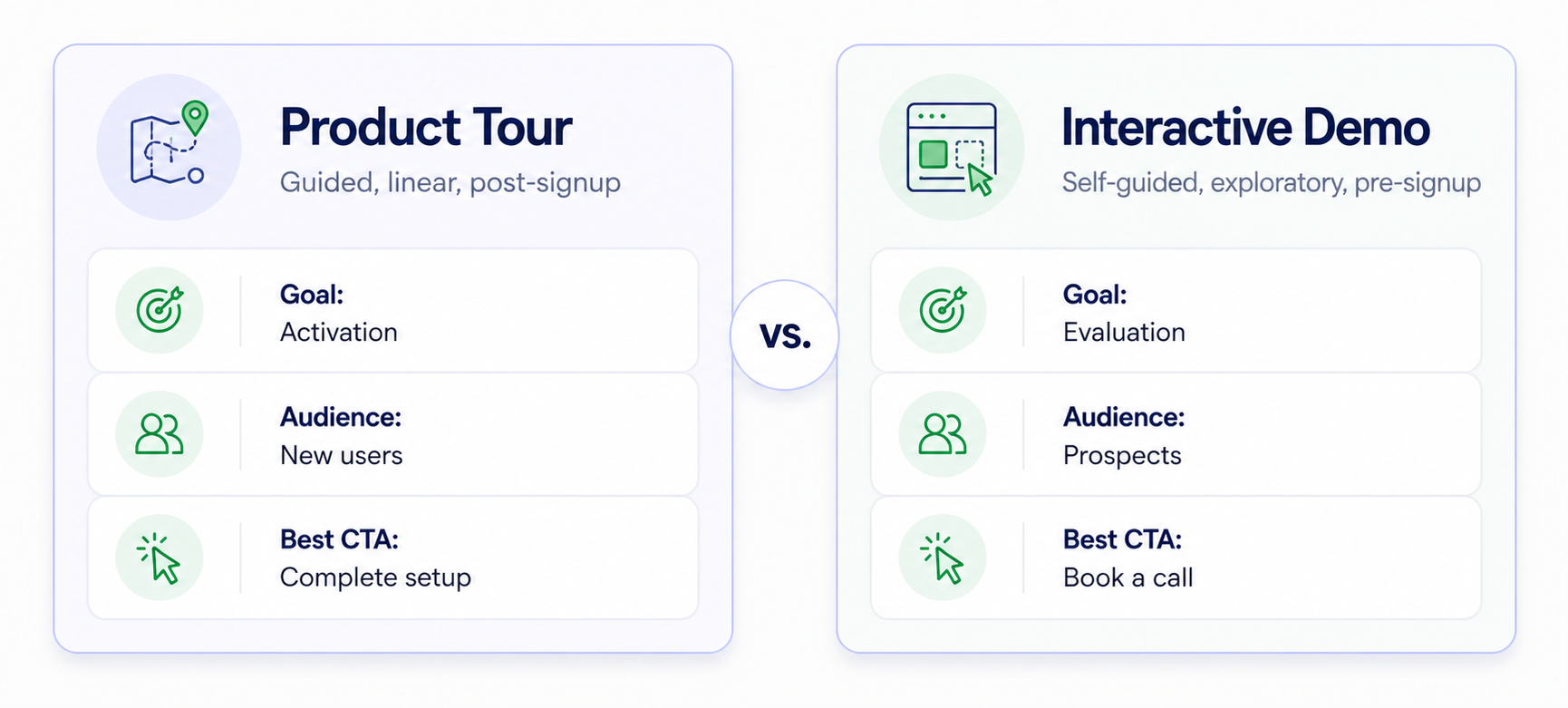
04 - Key Differences at a Glance
| Feature | Product Tour | Interactive Product Demo |
|---|---|---|
| Primary goal | Activation | Evaluation / conversion |
| Audience | New users (post-signup) | Prospects (pre-signup) |
| Navigation style | Guided, linear | Self-directed, exploratory |
| Depth | Focused — one core workflow | Broader — multiple use cases |
| Login required? | Yes (usually) | No |
| Primary use case | Onboarding, activation | Sales, marketing, PLG acquisition |
| Speed to value | Fast (for the new user) | Fast (for the evaluating prospect) |
| Where it lives | Inside the product | Marketing site, outbound, sales decks |
05 - Which Converts Faster?
Product tours convert faster for activation. Structured onboarding tours reduce the distance between signup and the first value moment. The strongest tours are short, segmented, and tied to one behavior change — not a full feature inventory. As Guideflow’s product tour guidance puts it, a product tour is a guided step-by-step walkthrough inside the product, while an interactive demo is a clickable simulation used for pre-purchase evaluation (Guideflow, 2026).
But “converts faster” for activation isn’t the same as “converts faster” for sales. Here the math flips entirely. Interactive demos win on sales conversion — and it isn’t close.
Interactive demos convert better for evaluation. They work before signup, before a sales call, and before a buyer is willing to trade calendar time for product context. That matters because Gartner found that 67% of B2B buyers now prefer a rep-free buying experience for at least part of their evaluation. An interactive demo gives those buyers a way to validate the product while their intent is still active, instead of forcing them into a form-and-calendar sequence.
The honest answer: product tours convert faster for onboarding. Interactive demos convert better for sales. Declaring one “better” without specifying the context is a category error — like asking whether a map is better than a compass. It depends entirely on where you’re trying to go.
06 - When to Use Each
The right tool depends on the moment in the buyer journey, the audience, and what “convert” means in that context.
Use a product tour when:
- You have a self-serve or PLG motion — users sign up without a sales call and need to find value independently
- Your activation rate is the biggest lever — more than 30% of signups churn before completing a core workflow
- The product is complex enough that a blank dashboard creates paralysis
- You’re onboarding users after a free trial or freemium sign-up
- Your use case is narrow and benefits from a fixed, linear guide to the one workflow that matters most
Use an interactive demo when:
- You’re trying to convert pre-signup prospects — people who haven’t committed to a trial or a call yet
- You have a sales-assisted or hybrid motion and want to compress the “first exposure” stage
- Your product is complex enough that prospects need to see it before they’ll book a demo call
- You’re running outbound and want to send the product instead of asking for 30 minutes
- You need a leave-behind after discovery — something the internal champion can share with stakeholders who weren’t on the call
- You want to generate behavioral data about what features capture attention before the sales conversation
| Scenario | Use Product Tour | Use Interactive Demo | Use Both |
|---|---|---|---|
| Homepage visitors need proof before booking | No — they are not inside the product yet | Yes — embed a self-guided product walkthrough | Only if signup happens immediately after the demo |
| Trial users stall after signup | Yes — guide the first high-value workflow | No — they already have product access | Yes, if the demo sets expectations before trial |
| Outbound prospects ignore meeting asks | No — a tour asks for too much commitment | Yes — send the product experience as the first ask | Later, after signup or free trial conversion |
| Enterprise stakeholders need a leave-behind | Sometimes — for implementation teams | Yes — give champions a shareable product story | Yes — demo for evaluation, tour for rollout |
The stage in the funnel determines the format. Prospect evaluating? Interactive demo. User onboarding? Product tour. Don’t use them interchangeably.
07 - The Strategy That Beats Using Either Alone
67% of B2B buyers now prefer a rep-free buying experience for at least part of their evaluation (Gartner, March 2026, n=646). The SaaS teams capturing that preference aren’t doing it with one format — they’re using a connected sequence.
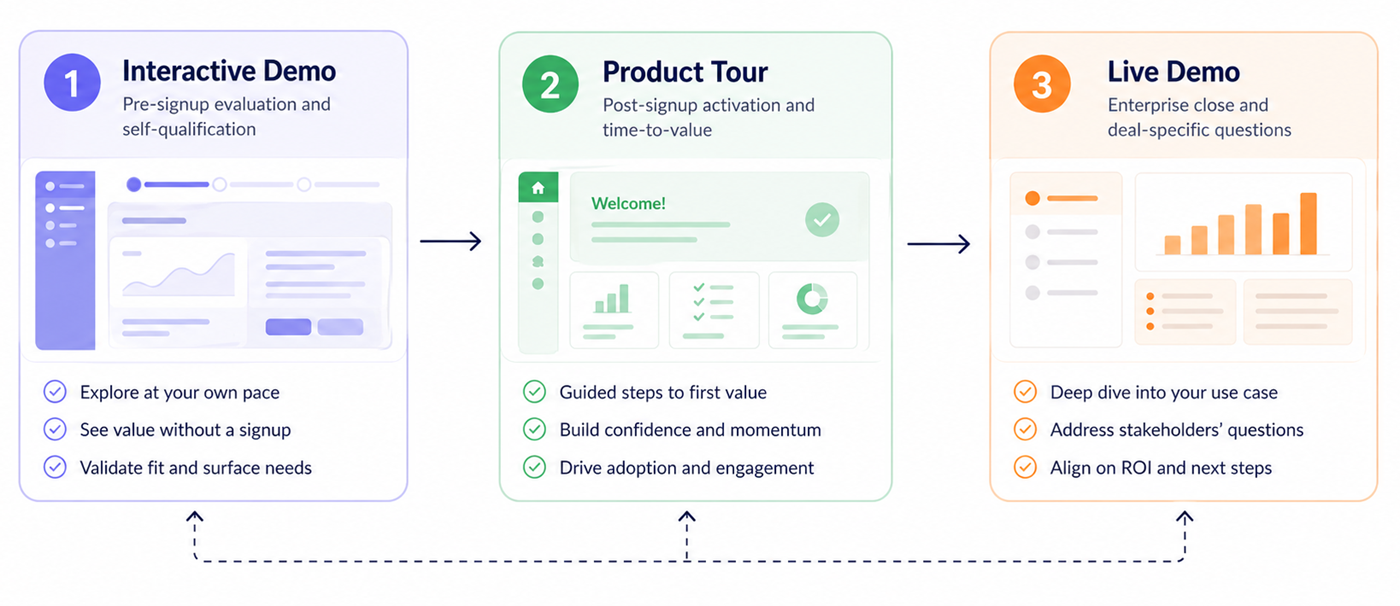
Here’s the three-stage model that top-performing PLG and hybrid SaaS teams are running in 2026:
Stage 1 — Interactive demo (pre-signup, pre-call)
This is the ungated product experience on your marketing site. A prospect who lands on your homepage — or receives a demo link in an outbound email — can explore your product without booking a call or creating an account. The interactive demo handles the “is this worth my time?” question that used to require a 45-minute intro call. For a detailed look at building one that actually converts, see our guide on how to create a product demo that converts.
Stage 2 — Product tour (post-signup, onboarding)
Once a prospect converts — signs up for a trial or creates an account — the product tour takes over. Its job is activation: getting that user to their aha moment before the end of week one. Without a tour, complex products lose users to the blank dashboard problem. With one, activation rates improve, early churn drops, and the cohort that sticks generates long-term revenue.
Stage 3 — Live demo (late-stage, enterprise close)
For enterprise deals, complex multi-stakeholder evaluations, or buyers who need a human relationship to cross the finish line, the live sales demo still closes. But by this point in the sequence, the prospect has already explored the product twice — once in the interactive demo, once in a trial. The live demo isn’t an introduction anymore. It’s a conversation about specifics. Sales cycles compress because the groundwork is already done. For a deeper look at that sequencing problem, see our guide to why gated sales demos lose deals.
The compounding logic: each stage reduces friction for the next. The interactive demo pre-qualifies the prospect. The product tour retains the now-qualified user. The live demo closes a buyer who’s already been through two product experiences and is self-selected for genuine interest. Every stage is doing less work than it would have to do alone.
08 - What This Looks Like in Practice
Abstract frameworks are easy to nod at and ignore. Here are three concrete patterns that separate teams doing this well from teams still debating the theory.
Homepage interactive demo — the silent qualifier
What it is: An ungated, embedded self-guided demo on the homepage or a dedicated “See how it works” page. Is it a tour or a demo? Demo — self-directed, no login, designed for evaluation. Why it works: The prospect gets a genuine product experience before they’ve committed to anything. By the time they click “Book a Demo,” they’ve already decided the product is worth 30 minutes. The sales rep gets a lead that already understands the product — and the conversation skips the introduction entirely.
Outbound leave-behind demo — the async pitch
What it is: A personalized interactive demo link sent after cold outreach or a discovery call. The demo might include the prospect’s company name in the data, industry-relevant workflows in the guided tooltips, and a CTA that routes to booking. Is it a tour or a demo? Demo — but with a guided overlay that structures the experience for a cold prospect. Why it works: Instead of asking for 30 minutes to explain the product, you send the product. The rep’s ask drops from “give me your time” to “click this link at your convenience.” Reply rates increase because the bar to engagement is lower.
Post-signup onboarding tour — the activation anchor
What it is: A 5-to-8-step guided tour that fires immediately after a new user creates an account. It skips the dashboard overview and drops them directly at the highest-value workflow — the moment where the product’s core value becomes tangible. Is it a tour or a demo? Tour — guided, linear, in-product. Why it works: It eliminates the blank-dashboard problem. Users who reach an aha moment in the first session retain at dramatically higher rates than those who don’t. The tour manufactures that moment on purpose rather than leaving it to chance.
09 - Common Mistakes That Kill Conversions
The format only works if the execution is right. Here are the mistakes that consistently undercut both product tours and interactive demos — and what to do instead.
Coda - The Decision
If you only use interactive demos, you solve the sales problem but ignore the retention problem. Users who convert but never activate churn — and churn is just delayed acquisition cost.
If you only use product tours, you improve onboarding for the users who make it to signup — but you’ve done nothing to make the evaluation experience easier for the much larger audience that never commits to a trial at all. Tours don’t reach that audience. Demos do.
The best SaaS products in 2026 use both — not because it’s theoretically correct, but because the data makes the case clearly. An interactive demo before signup, a product tour after. Each format doing exactly the job it was built to do. Neither forced into a role it wasn’t designed for.
The fastest-converting SaaS funnel isn’t built around the best demo. It’s built around the right demo at the right moment.
FAQ - Common Questions
What is an interactive product tour?
An interactive product tour is a guided, step-by-step walkthrough of a product’s core features — typically 5 to 10 steps in a fixed sequence. It’s designed to get a new user from signup to their first moment of value as quickly as possible, using tooltips, spotlight overlays, and progress indicators to direct attention. Tours are almost always in-product or simulated, and are optimized for onboarding rather than sales evaluation.
What is an interactive product demo?
An interactive product demo is a clickable, self-guided simulation of your product that runs in a browser — no login, no sales call, no setup. Unlike a product tour, it lets the user choose their own path through the product. It’s a sales and marketing asset designed for pre-signup prospects, and can be embedded on your homepage, sent in outbound sequences, or shared as a leave-behind after discovery calls.
Which is better for SaaS — a product tour or an interactive demo?
Neither is universally better — they solve different problems. Product tours convert faster for activation because guided onboarding gets new users to a specific value moment after signup. Interactive demos convert better for sales evaluation because they let prospects explore before a trial or sales call. The highest-performing SaaS teams use both in sequence — interactive demo before signup, product tour after.
Are interactive demos better than live sales demos?
For early-stage qualification, yes — interactive demos work 24/7, require no scheduling, and let prospects self-qualify before talking to a rep. For late-stage enterprise evaluation, live demos remain essential: a human relationship closes complex deals in ways a simulation can’t replicate. The right model is sequential: interactive demo for early evaluation, live demo to close.
What is a self-guided demo?
A self-guided demo — also called a self-serve interactive demo — is a product experience that the prospect controls entirely, without a salesperson present. They click through the product at their own pace, following their own path, rather than watching a guided presentation. Self-guided demos lower the barrier to engagement because the first ask is a click, not a 30-minute meeting.
Statistics cited reflect industry research from Gartner and product onboarding benchmarks. Individual results vary by product category, target market, and execution quality.
Build interactive demos that close deals.
No engineering team required. Go from Chrome capture to a shareable, trackable demo in minutes.
Start Free Trial